Deadlines often live inside PDFs, messages, emails, and academic documents. The important action is buried inside unstructured text, which makes it easy to miss.
Clario
A local-first productivity system that extracts possible deadlines from documents and turns them into reviewable tasks, calendar items, and summaries.
Full-stack / Product design / AI workflow
Next.js / Tailwind / OCR / NLP / SQLite/local-first
A trust-first workflow for converting unstructured academic material into reviewed actions.
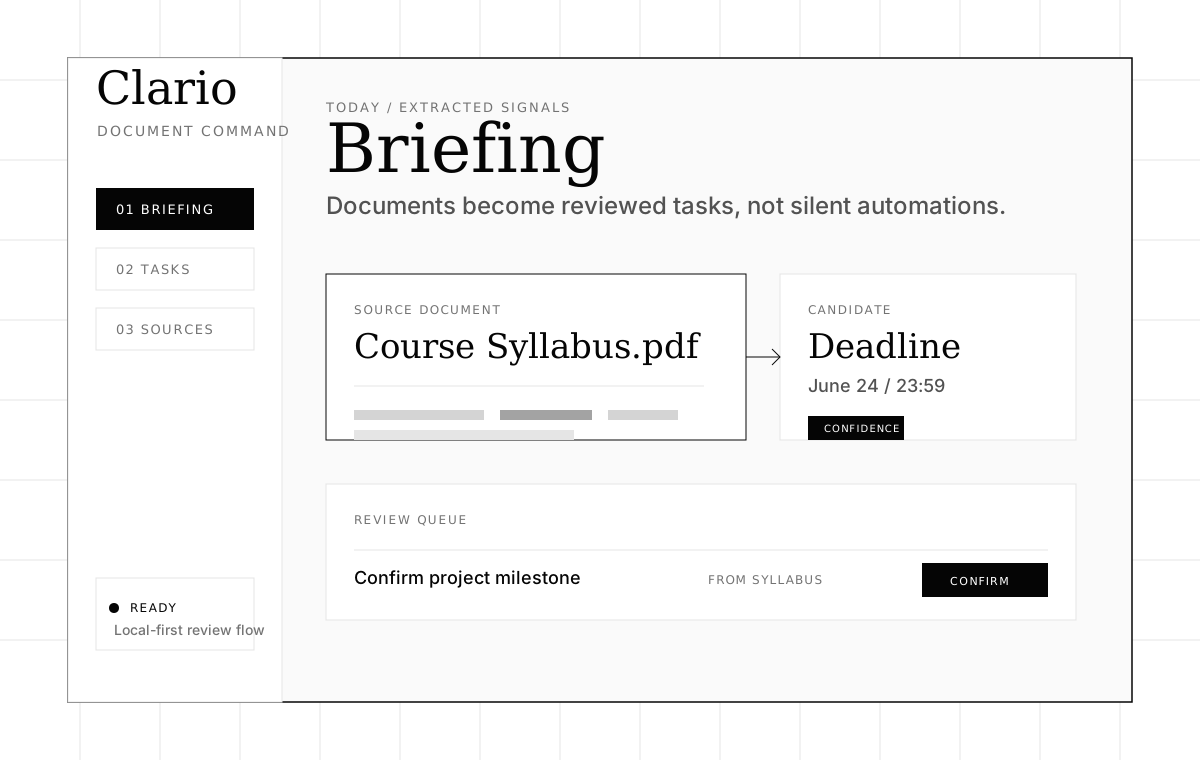
Monochrome Clario interface wireframe with source document, extracted deadline candidate, and review queue.
Problem
Deadlines often live inside PDFs, messages, emails, and academic documents. The important action is buried inside unstructured text, which makes it easy to miss.
What I Built
Create a calm review workflow that extracts possible deadlines, summarizes source documents, and asks the user to confirm changes before modifying tasks or calendars.
- Document intake for academic files and notes.
- OCR / parser layer for turning source material into text.
- Deadline extraction candidates with review context.
- Confirmation flow before a task or calendar item is created.
System Design
The work is organized around the data flow: inputs, transformation steps, review points, and outputs. Keeping those boundaries explicit makes the system easier to test and iterate.
- Document input
- OCR / parser
- Deadline extraction
- Review candidate
- Task / calendar output
Technical Decisions
Keep extracted deadlines as candidates until the user confirms them.
AI extraction can be wrong, and productivity systems need user trust before writing to a task or calendar surface.
The workflow adds a review step instead of making the system fully automatic.
Start local-first before adding sync or collaboration.
The early product risk is workflow quality, not distributed data complexity.
Cross-device behavior and shared calendars are deferred until the extraction loop is stronger.
Separate source documents, extracted candidates, and confirmed tasks.
Each record has a different trust level and should not be treated as the same domain object.
The data model is slightly more explicit, but the interface can show evidence and confirmation states clearly.
Use a monochrome review interface.
The product handles deadlines and evidence; a restrained interface keeps attention on review quality.
The visual system relies on hierarchy, spacing, and structure instead of color-coded status shortcuts.
Interface Decisions
Draft notes will be added as the project changes.
- Use a stable rail and structured panels so users can scan documents, candidates, and confirmed actions without losing context.
- Show confidence and source context as evidence, not decoration.
- Keep assistant actions structured around review and confirmation instead of open-ended automation.
Current Status
Prototype / in development. A trust-first workflow for converting unstructured academic material into reviewed actions.
- Balancing speed with trust in an AI-assisted productivity workflow.
- Designing review states that are obvious without turning the interface into a noisy dashboard.
- Planning parsing and extraction boundaries before real document benchmarks exist.
Next Iteration
Draft notes will be added as the project changes.
- Integrate better document parsers and OCR quality checks.
- Create extraction benchmarks for deadline accuracy.
- Test how much source evidence users need before confirming an extracted task.