Camera-based sensing can expose sensitive visual information. Wireless signal-based sensing offers another path, but it needs careful experimentation and privacy-aware interpretation.
WiFi CSI Sensing
A research prototype studying WiFi Channel State Information as a privacy-aware sensing signal instead of direct camera-based input.
Research / Experiments / Signal processing / ML
Python / WiFi CSI / ML / Data processing
A technical research direction connecting sensing, machine learning, signal processing, and privacy constraints.
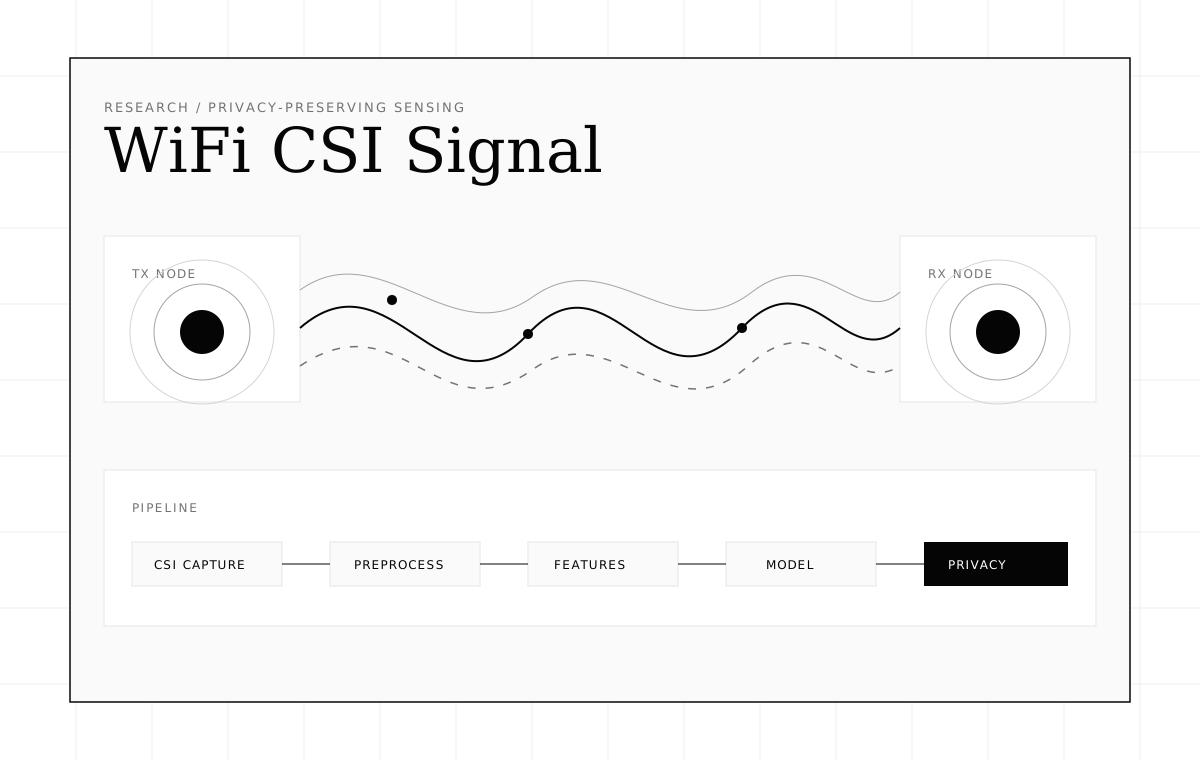
Monochrome WiFi CSI sensing diagram with transmitter, receiver, signal curves, and privacy-aware pipeline.
Problem
Camera-based sensing can expose sensitive visual information. Wireless signal-based sensing offers another path, but it needs careful experimentation and privacy-aware interpretation.
What I Built
Explore whether WiFi CSI signal patterns can support sensing tasks while avoiding direct visual capture and documenting privacy constraints.
- CSI capture and controlled data collection workflow.
- Preprocessing for noisy wireless signal data.
- Feature extraction for model experiments.
- Privacy-aware interpretation of sensing outputs.
System Design
The work is organized around the data flow: inputs, transformation steps, review points, and outputs. Keeping those boundaries explicit makes the system easier to test and iterate.
- CSI capture
- Preprocessing
- Feature extraction
- Model / analysis
- Privacy evaluation
Technical Decisions
Use WiFi CSI signals instead of camera-based sensing as the primary input.
Wireless signals can support sensing experiments without collecting direct imagery.
Signal interpretation is less visually intuitive and requires stricter experimental controls.
Separate preprocessing from feature extraction.
CSI data is noisy, and cleaning assumptions should be inspectable before model behavior is evaluated.
The pipeline has more steps to document, but experiment changes become easier to isolate.
Frame model outputs through privacy-aware interpretation.
The research question is not only whether sensing works, but what information the system exposes.
Results need more careful explanation than a simple accuracy score.
Interface Decisions
Draft notes will be added as the project changes.
- Present the work as a signal pipeline rather than a consumer product interface.
- Use nodes, curves, and process blocks to make the invisible sensing workflow legible.
- Avoid visual metaphors that imply camera-like observation.
Current Status
Research. A technical research direction connecting sensing, machine learning, signal processing, and privacy constraints.
- Wireless signal data can vary with environment, hardware, and collection setup.
- Privacy claims require careful boundaries and cannot be inferred from model accuracy alone.
- The research artifact needs to communicate uncertainty clearly.
Next Iteration
Draft notes will be added as the project changes.
- Refine controlled experiment design and data collection notes.
- Compare model behavior across sensing conditions.
- Document privacy assumptions and failure modes more explicitly.